Knowing When to End: The Gracious Close to a Racquet Lunch
A clear ending protects the warmth of a gathering and gives guests a comfortable way to leave.
Three adults say goodbye outside a clubhouse beside gathered sports bags.
Read articleThe archive
Explore 201 published stories on the places, rituals and people shaping life around the court.
Newest first

A clear ending protects the warmth of a gathering and gives guests a comfortable way to leave.
Three adults say goodbye outside a clubhouse beside gathered sports bags.
Read article
Name the effort you appreciated and one detail you remember, then let a personal thank-you stand on its own.
A blank cream card, envelope, pen, and folded napkin lie on a wooden table.
Read article
Design a small court-side celebration around conversation, movement, and a table that can be cleared without a production crew.
Three guests converse beside low flowers, folded linen, and a blank place card.
Read article
Set a reliable handoff from tennis to brunch so guests can enjoy both without an unfinished match controlling the table.
Four guests gather for coffee at a brunch table with covered serving dishes.
Read article
Give an after-padel aperitivo a clear shape: a brief pause, a considered drink choice, and conversation that does not become an unplanned dinner.
Two guests share drinks and small bites at a terrace table.
Read article
Design the conversation, seating, and shared moments so a nonplaying guest has a full invitation of their own.
Three guests converse around a low table on a covered club terrace.
Read article
When two people cohost client tennis, a shared promise and clear handoffs matter more than dividing a task list.
Two cohosts talk over a blank card at a small terrace table.
Read article
Give a solo arrival a natural first connection, then room to choose their own way into the gathering.
A host greets an arriving guest beside a seated woman at a clubhouse entrance.
Read article
A short welcome can give guests confidence without turning a relaxed court gathering into a meeting.
A standing host welcomes three seated guests on a shaded tennis terrace.
Read article
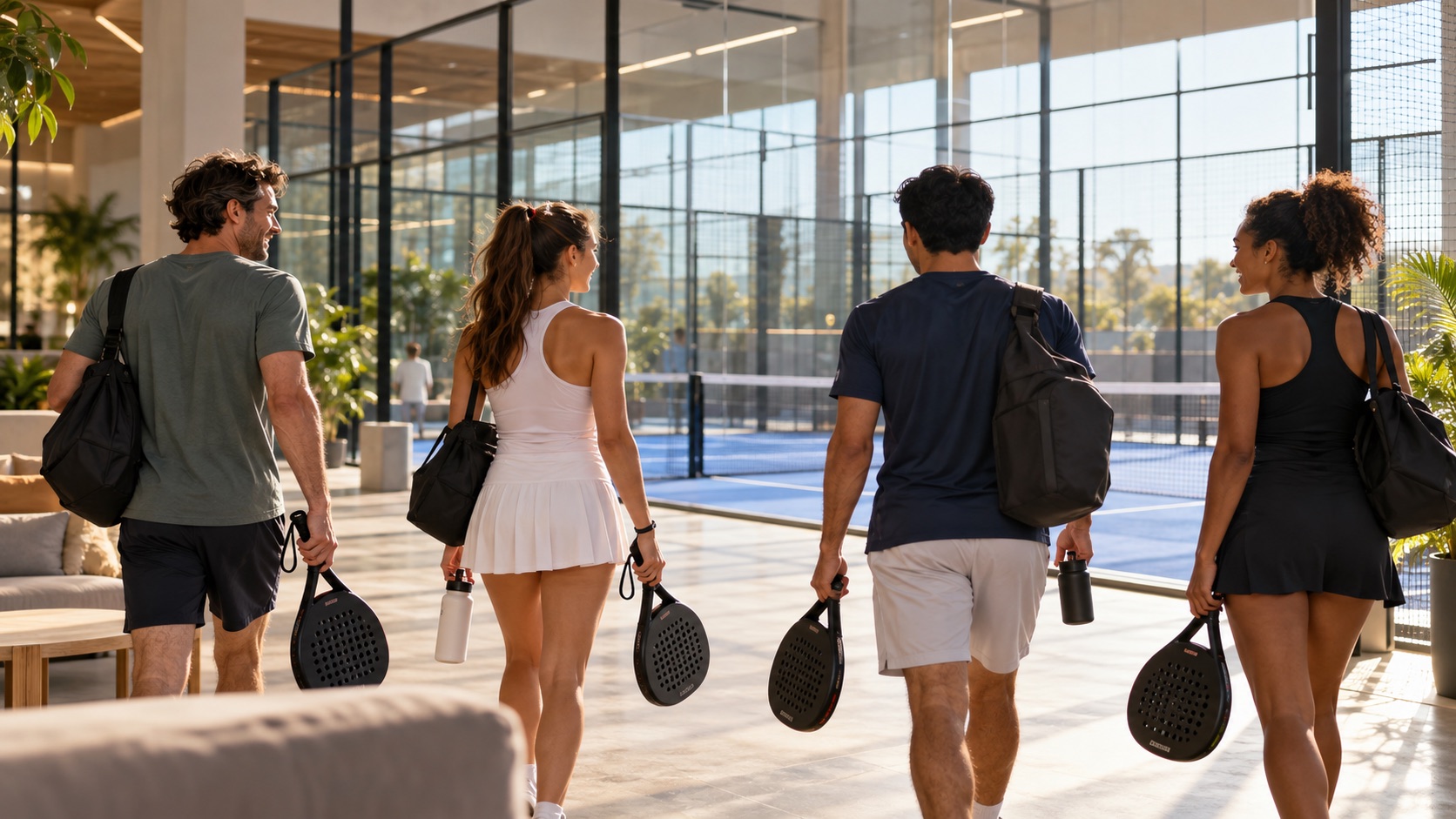
A one-court padel gathering needs a fair playing plan and a social space that makes time off court feel intentional.
Four adults converse in a lounge beside an enclosed padel court, with sports bags nearby.
Read article
Calusa Park and the Ritz racquet complex present different access questions. Here is what the official pages establish—and what still needs confirmation for a specific game.
A woman carrying a sports bag speaks on a phone beside a planted entrance.
Read article
Miami padel addresses can offer very different settings. Compare the actual branch, court environment and access terms before letting a club name decide the day.
Two adults look at a paper plan on a terrace overlooking enclosed courts.
Read article
Pickleball has two distinct serving methods. Understand the volley serve and drop serve on their own terms before working on a more repeatable start.
A close view of a person holding a yellow pickleball and a dark paddle.
Read article
A cooperative dink exchange makes placement easier to see. Give the ball a shared purpose before turning a short-court practice into a contest.
Two adults holding pickleball paddles converse beside a net.
Read article
Tennis experience gives you useful reference points for padel, but the enclosure changes how a point develops. Decide which habits transfer and which need a new explanation.
A seated man examines a padel racquet, with a tennis racquet leaning beside him.
Read article
A legal padel serve has a specific starting area, bounce and contact height. Establish those first, then let a coach help you build useful placement.
A close view of a person holding a ball and padel racquet.
Read article
The back glass can give a padel rally another chapter. Learn to distinguish a legal rebound from a second ground bounce before adding the shot to your game.
A woman holds a ball and padel racquet beside a glass wall.
Read article
Doubles positions change with the ball. Start by separating the serving and receiving roles from the formations your pair chooses during a point.
Four adults holding tennis racquets converse beside a net.
Read article
Separate the toss, contact and complete serve so a lesson can solve one problem at a time. A repeatable start matters more than borrowing a professional motion.
A woman holds a tennis ball on her open palm and a racquet while facing another person.
Read article
A cooperative rally gives two beginners a shared task. Learn how to distinguish a playable ball from a winner and make the next exchange more useful.
A tennis racquet and basket of practice balls rest beside a wooden bench.
Read article
When a child stops enjoying a racquet sport, begin with what has changed for them. A conversation can clarify the next choice without diagnosing the child or defending the original plan.
A woman and child converse on a bench, with a racquet bag on the ground.
Read article
A day without a court reservation can leave room for family play on different terms. Offer a few real choices without turning the afternoon into substitute training.
Two children play with a large red ball on grass while an adult stands nearby.
Read article
Rothko Chapel shows how daylight and art can define a room’s purpose. Its restoration offers a precise subject for looking, without a prescribed way to feel.
A person holds a small architectural model with daylight falling through its top opening.
Read article
Mohonk’s greenhouse brings the work behind a resort garden into view. For a tennis guest, it offers a different kind of lesson: how the surrounding landscape is made.
Two adults converse beside seedlings and gardening tools in a greenhouse.
Read article
A dark-sky stay depends on decisions made before the stars appear. Under Canvas Lake Powell–Grand Staircase shows how lighting, operations and education enter the experience.
An unlit canvas tent stands beneath a dark starry sky in a desert landscape.
Read article
A landscape has an acoustic character as well as a view. National Park Service interpretation offers a way to notice it without turning listening into another performance task.
A man stands on a wooded path beside a stream.
Read article
An outdoor artwork changes what a path invites you to notice. Crystal Bridges and Sensei Lanai show two different relationships between art, landscape and leisure.
Two adults stand beside an abstract looping sculpture in a garden.
Read article
Portland Japanese Garden’s Cultural Village makes material and craft part of the visit. Its cedar offers a more precise story than a generic promise of calm.
A woodworker planes a timber board, with curled shavings on the workbench.
Read article
Fordyce Bathhouse places the modern spa beside an older culture of rooms, rituals and social life. Read the building as history, not as a prescription.
A person holds an open book of architectural drawings beside a tiled wall.
Read article
At Amangiri, the landscape is part of the architectural argument. Its designers offer a useful way to look beyond a spa menu and notice the setting itself.
A person sits facing a tall opening that frames a desert landscape.
Read article
Build an annotated court-style archive that reveals your preferences and helps you use what you already own.
A visor, fabric swatches and abstract color studies arranged on a wooden worktable.
Read article
Borrow one documented tennis detail from Lacoste or Fred Perry history and let the surrounding proportions belong to the present.
A man wearing a cream textured polo with dark collar trim and dark trousers in a club corridor.
Read article
Plan a family court portrait through background, color relationships, and individual choices rather than identical outfits.
Five family members in navy, cream and pale blue clothes gathered against a light wall with racquets and bags.
Read article
Programs, pins, and trophies can tell different parts of a club’s history when their context and uncertainty are preserved.
A small trophy, racquet pin, closed blue book and wooden tennis racquet arranged on a table.
Read article
Begin a tennis photography collection with a point of view, then distinguish the image you love from the print you are acquiring.
A man viewing three framed, stylized sporting images in a quiet home interior.
Read article
Explore locker rooms through thresholds, storage, and privacy, with the Cincinnati Open player building as an architectural reference.
An empty changing-room entrance with wooden storage bays, padded benches and a clear central passage.
Read article
Breuer’s documented cane-and-chrome chairs provide a precise lens for understanding openness, reflection, and material contrast.
A close view of woven cane beside a curved polished metal chair frame.
Read article
Read clubhouse seating as an invitation to converse, watch, or withdraw, using Thonet and Eames museum objects as references.
Guests gathered around a clubhouse table while another guest sits in a separate lounge chair near a window.
Read article
Consider the racquet cover through its outline, edge, opening, and material description as an everyday designed object.
A cream racquet cover with dark piping leaning against a wooden entryway bench.
Read article
Use the cap or visor as a deliberate silhouette, informed by tennis history and the proportions of your current clothes.
A cream visor and navy cap on a wooden bench beside a canvas bag.
Read article
Two official resort examples show how padel is entering American luxury hospitality, without turning a few properties into a market forecast.
Four adults holding plain padel racquets while talking on a planted resort terrace.
Read article
Read a resort review through its author’s circumstances, separating useful impressions from facts that need current confirmation.
A seated man holding a plain book in a hotel reading corner, with a racquet bag beside him.
Read article
Mount Washington’s hotel and tournament histories offer a precise way to read the Northeast grand resort’s tennis tradition.
Guests seated on a long mountain hotel veranda, with two tennis bags against the wall.
Read article
La Quinta’s 1926 casitas and 1937 tennis expansion tell a specific story about desert architecture and organized leisure.
A desert casita courtyard with cushioned chairs, terracotta roofs and a racquet cover leaning against a chair.
Read article
Understand the hotel and specialist partnership behind a racquet program through Omni Amelia Island’s documented example.
Three adults carrying bags and talking beside a display of racquets in a club entrance.
Read article
An extended Key Biscayne stay gains depth through Crandon Park, Cape Florida, and the history beyond a tennis appointment.
Two adults beside a bench overlooking a flat tropical coast, with a racquet bag leaning against the bench.
Read article
Mohonk’s layered architecture reveals how lounges, public rooms, and museum objects can give a family stay its social shape.
Guests reading and conversing in a lakeside hotel lounge, with a plain black racquet bag beside a sofa.
Read article
Explore the domestic scale of Sea Island cottage life, where shared rooms connect a family to a wider resort.
Three people of different generations sharing breakfast in a coastal cottage, with a covered racquet by the doorway.
Read article
Give a Sea Island racquet trip a coastal chapter through its Nature Center and the questions a landscape invites.
Two adults looking across a marsh from a wooden boardwalk, with a racquet bag on the deck.
Read article
Read The Broadmoor through its social history, racquet program, and different scales of mountain leisure.
Two adults holding cups in a mountain lodge lounge, with a racquet bag beside the window.
Read article
Respond to a tense friendly-match moment with clear boundaries, realistic options, and appropriate venue support.
Two players with racquets lowered talking with another adult beside a court bench.
Read article
Plan clear written details and considerate conversation for guests who prefer different languages at a US court gathering.
Three adults conversing attentively beside a tennis terrace.
Read article
Give late arrivals a clear meeting point, reachable contact, and predictable way to join the gathering.
An arriving man with a plain white bag being greeted in a shaded seating area.
Read article
Clarify plus-one invitations and handle exceptions without confusing venue capacity with a guest’s social importance.
Three adults having a cordial conversation outside a club entrance.
Read article
Agree on taking, sharing, and republishing family court photographs before the camera becomes part of the gathering.
Two women talking, one holding a lowered camera, with a family gathering behind them.
Read article
Create a welcoming gathering after a junior match without turning the meal into an unwanted review of the score.
Four people of different ages talking over a garden lunch near tennis courts.
Read article
Invite a family new to tennis with clear expectations about the format, equipment, teaching support, and choices for participation.
Two adults and a child being welcomed by another adult at a tennis-court entrance.
Read article
Arrange a clear drinks station with visible choices, sensible glass handling, and a defined replenishment plan.
A man pouring water into a woman’s glass at a terrace drinks station.
Read article
Use line, color, and repetition to set a racquet-inspired table that stays comfortable for conversation and service.
A green-clothed outdoor table set with ivory plates, glasses, and bordered napkins.
Read article
Assign a few clear hosting roles so arrivals, venue questions, and refreshments receive attention while the hosts also enjoy the gathering.
Two adults talking near a club entrance as guests approach in the background.
Read article
Keep a small racquet-resource list with official links, clear access status and a last-checked date, so useful information does not turn into stale advice.
An adult holds a small blank card beside a laptop, map and tennis racquet.
Read article
Compare junior racquet programs through age and experience fit, supervision arrangements, communication and the child’s own response to the setting.
A parent and child ask a coach about a junior racquet program.
Read article
Compare public courts and club access using the bookings you actually want, including reservation priority, guest arrangements and ongoing commitments.
A player considers a local public tennis court.
Read article
Choose a useful alternative when a court booking cannot go ahead, while keeping cancellation decisions and refunds with the responsible venue or organizer.
Friends meet at a café while rain falls outside.
Read article
Confirm the invitation’s scope, check-in arrangements and charges before visiting a racquet club, then let the local rules guide the day.
A guest meets her host at a fictional racquet-club reception.
Read article
Give a recurring racquet group a clear confirmation deadline, a fair substitute process and one place to find the current booking.
An organizer checks a message as friends arrive for a racquet session.
Read article
Choose a first shared racquet sport around the people, local access and kind of session you want, rather than a universal claim about which is easiest.
Friends compare a tennis racquet, a padel racquet and a pickleball paddle.
Read article
Compare beginner pickleball sessions by what happens during the booking, who explains the game and what experience is expected on arrival.
A beginner asks an instructor about a pickleball session.
Read article
Return to tennis with an honest account of your playing history, current preferences and the rules of the format you want to join.
An older man and a younger man talk beside a wooden-framed tennis racquet.
Read article
Turn a coach’s agreed objective into a manageable practice appointment, with the right space, a willing partner and useful notes for the next lesson.
A tennis player makes a note beside a practice court.
Read article
Ask how a home’s ventilation is operated and maintained, then distinguish documents, observations and unanswered questions before drawing conclusions.
Two adults talk beneath a ceiling ventilation grille in an empty apartment.
Read article
Protect open time by checking the full footprint of sports commitments, then decide which invitations belong in an already crowded week.
Two adults discuss a large calendar grid at a table.
Read article
Agree what a friendly result means before playing, and keep feedback, scorekeeping and post-match conversation in proportion to the occasion.
Two recreational tennis players acknowledge a finished game.
Read article
Create a practical handoff from work to court time: finish one loose end, manage the arrival and tell partners what kind of session you want.
An adult picks up a sports bag at the end of a workday.
Read article
Plan a household dinner around different arrival times and familiar choices, without making the meal a reward or a recovery formula.
A household prepares an ordinary dinner together after a busy day.
Read article
Check day-use limits, lock arrangements and privacy rules before settling into a club locker, then make departure part of the routine.
A player collects her bag beside a day locker.
Read article
Choose a spa gift card around the recipient’s preferred location and redemption options, rather than assuming a balance guarantees an appointment.
Hands hold a blank card and an envelope over a wooden table.
Read article
Unscented and fragrance-free describe different things. Read the product information before choosing toiletries for your court bag.
Unbranded toiletries and a small personal-care pouch on a shelf.
Read article
Ask about the route, locker and changing space before a first club visit, using your own access preferences to guide the conversation.
A wheelchair user and a staff member discuss changing-room arrangements at a fictional club.
Read article
Before a wellness membership renews, compare the next charge, pause options and cancellation process against the way you actually use it.
A woman holds a tablet and a folder at a breakfast table beside a sports bag.
Read article
Explore how court palettes relate to architecture and landscape while keeping technical surface decisions with qualified professionals.
An empty blue-and-green tennis court surrounded by stone walls, trees, and a shaded pavilion.
Read article
Look at court numbers, signs, and scoreboards as a coherent information system that supports a club’s visual identity.
A player entering a tennis court beside a navy sign with the numeral seven.
Read article
Choose a court towel through size, texture, borders, and graphics while keeping its intended use in view.
A folded white towel with a navy border beside a plain court bag.
Read article
Choose purposeful lettering, placement, and scale for personalized racquet accessories, with a clear approval process before ordering.
A plain green racquet bag with a blank tan leather tag beside a clay court.
Read article
Decide whether a court garment needs repair, alteration, replacement, or simply a different role in your wardrobe.
Hands repairing a white polo shirt on a table beside thread and a loose button.
Read article
Inspect, clean, and store tennis whites with a practical routine that makes the next season easier to prepare for.
White shirts and a pleated skirt arranged on wardrobe shelves beside a tennis bag.
Read article
Compare piqué, rib, and smoother knits through texture, light, and the details of the finished garment.
Three folded fabrics with different visible textures on a wooden table.
Read article
Evaluate mesh placement, opacity, and detailing without mistaking a material name for a performance guarantee.
Close view of a white polo shirt with a mesh shoulder panel.
Read article
Learn to read pleats, panels, and seams so a tennis skirt’s construction becomes a clear design choice.
An ivory pleated skirt hanging on a changing-room wall, with a seated person in the background.
Read article
Inspect pocket placement, construction, and loaded fit to choose court clothing that works with what you actually carry.
Navy tennis shorts with a ball partly visible in a side pocket.
Read article
Separate hotel, court, and program calendars when planning a Northeast racquet stay near a seasonal transition.
An empty outdoor tennis court beside a building and autumn trees.
Read article
Verify a vacation-rental listing, court access, and current condition before making a private tennis court the reason you book.
Two racquet bags rest beside chairs on a vacation-house terrace.
Read article
Check the privileges attached to a coastal Carolina residence by booking channel, registered guests, and the court sessions you actually want.
A woman sitting on a shaded coastal porch beside a tennis bag and tree-lined path.
Read article
Compare hotel rooms, villas, and residences through privacy, household routines, court routes, and booking privileges.
A villa sitting room opening toward a garden and tennis court, with a weekend bag beside the doors.
Read article
Define private spaces, court control, and guest logistics before committing to a small-group racquet buyout.
An empty dining terrace overlooking tennis courts and distant hills.
Read article
Use age bands, program calendars, and sibling handoffs to choose a school-break tennis stay that works for the whole family.
An adult and two children carrying bags toward a resort court entrance.
Read article
Coordinate tennis and pickleball reservations so different family preferences fit one relaxed resort itinerary.
A tennis racquet and a solid pickleball paddle resting on a wooden bench.
Read article
Match an Amelia Island tennis program to a teenager’s experience, preferences, and travel dates before reserving the stay.
A teenager and two adults talking beside an empty tennis court.
Read article
Compare age policies, shared spaces, and playing groups to choose the resort atmosphere that fits your racquet break.
Two empty garden chairs facing a tennis court, with a small gathering on a separate terrace.
Read article
Choose a room and court schedule that accommodate real work obligations, with practical checks for privacy, transitions, and reliable playing time.
A closed laptop on a hotel-room desk, with a racquet bag by an open doorway.
Read article
Choose between a seated lunch and a standing reception using duration, conversation, access, and the service arrangements behind each format.
AI-generated scene of a garden pavilion with a seated lunch table and two standing reception tables.
Read article
Give an assistant a complete racquet-event brief, a defined response, and clear updates without transferring unresolved personal decisions.
AI-generated scene of a man holding a closed folder while talking with a woman at a club reception counter.
Read article
Write a personal follow-up after tennis that keeps appreciation clear and any professional request separate and optional.
AI-generated still life of a sealed cream envelope and fountain pen on a wooden table, with a tennis bag behind.
Read article
Handle business topics during a social match with clear, modest boundaries and follow through only on the commitment actually made.
AI-generated scene of two men talking beside a tennis court with their racquets lowered.
Read article
Make court-side introductions with clear names and a useful shared interest, while leaving private details and future connections to the guests.
AI-generated scene of three adults greeting one another at a garden gate.
Read article
Plan a discreet family office padel afternoon with clear invitations, limited data sharing, photography choices, and voluntary conversation.
AI-generated scene of three adults talking in a lounge beside a glass-walled padel court.
Read article
Keep a useful host’s debrief: record what happened, separate service issues from preferences, and turn observations into a few practical changes.
AI-generated scene of a man collecting glasses from a table overlooking a tennis court.
Read article
Build a small racquet guest list around the shared experience, with room for newcomers and without ranking people by influence.
AI-generated scene of six adults chatting in two groups in a landscaped club courtyard.
Read article
Ask about playing experience privately and use the answers to choose a suitable format without assigning guests a public label.
AI-generated scene of two adults talking on a wooden bench beside a tennis court.
Read article
Write a tennis invitation that explains the format, arrival, equipment, payment arrangement, and reply without losing its warmth.
AI-generated scene of one man handing a sealed envelope to another on a racquet-club porch.
Read article
Organize four fixed doubles teams across two courts with a complete three-round schedule and clear plans for time limits and cancellations.
An organizer prepares a clipboard and colored team markers beside courts. Fictional setting.
Read article
Agree on simple partner messages, clarify score questions, and ask before offering feedback in recreational pickleball doubles.
Two pickleball partners speak between games. Fictional setting.
Read article
Navigate a first pickleball open play by checking eligibility, learning the rotation, and being a clear new partner.
Three plain pickleball paddles wait in a rack while two players talk nearby. Fictional setting.
Read article
Follow the first four pickleball shots to see which side must allow a bounce and when a legal volley becomes an option.
An instructor holding a pickleball talks with two adult beginners. Fictional setting.
Read article
Understand kitchen-rule situations by separating a bounce from a volley, checking the line, and following the player’s momentum.
AI-generated editorial illustration of a pickleball instructor and adult learner discussing a question at a sideline bench. Fictional people and venue.
Read article
Use a padel clinic well by choosing the right level, bringing a clear question, and leaving with an understandable next step.
Three padel beginners listen to an instructor with their rackets lowered. Fictional setting.
Read article
Find a padel partner by making the level, tone, timing, and booking responsibilities in your invitation clear.
Two padel players discuss a phone beside a glass court entrance. Fictional setting.
Read article
Choose a tennis coach using verifiable experience, clear booking terms, and a teaching approach you can understand.
A player and prospective coach discuss an appointment beside a tennis pavilion. Fictional setting.
Read article
Compare real group and private lesson offers by goals, scheduling, level, included access, and the commitment behind the price.
An adult asks about lesson options at a reception desk, with a small group outside. Fictional setting.
Read article
Prepare for a first private tennis lesson, from the opening conversation to a clear recap and an informed next booking.
An adult beginner and instructor talk on a bench beside a tennis court. Fictional setting.
Read article
Replay an ordinary week in a candidate residence to compare daily advantages, recurring compromises, and occasional amenities.
Two adults discuss an apartment layout with a representative during a tour. Fictional setting.
Read article
Translate residential spa language into confirmed operating services, booking terms, provider responsibilities, and everyday convenience.
An empty residential treatment-room entrance includes a reception ledge and towels. Fictional setting.
Read article
Test a home layout against bags, laundry, school things, and the busiest half hour of an active family’s day.
An adult helps a child put a bag into entryway storage. Fictional setting.
Read article
Compare balconies, gardens, and shared green space using the activities, access steps, privacy, and upkeep that matter to you.
Two adults sit at a small balcony table overlooking shared greenery. Fictional setting.
Read article
Plan bedroom storage, light controls, and circulation around ordinary evenings and different household schedules.
A bedroom has reading lamps, organized storage and a clear walking route. Fictional setting.
Read article
Test residential court access against a real doubles booking, including guests, lighting, maintenance, and instructor permissions.
An entry gate frames a residential tennis court and nearby homes. Fictional setting.
Read article
Evaluate a residential fitness room through access hours, maintenance, peak-time use, and the route from your apartment.
An empty residential fitness room has exercise equipment and storage near a clear entrance. Fictional setting.
Read article
Audit optional wellness tracking by the decisions it supports, the attention it takes, and the data settings you want to keep.
A woman adjusts a fitness wristband beside a laptop and notebook. Fictional setting.
Read article
Plan shared active time when one partner wants competition and the other wants an introduction, with clear choices about lessons and time together.
Two adults discuss shared active plans at an outdoor table. Fictional setting.
Read article
Choose practical phone boundaries for court time, including access codes, urgent calls, photography, and group messages.
A hand puts a phone with its screen off into a plain tennis bag. Fictional setting.
Read article
A polo collar’s appearance depends on its construction, attachment and care. Inspect those details before expecting a shirt to keep the shape you like.
A close view shows the ribbed collar, seam and placket of an ivory piqué polo.
Read article
Fabric finish changes how the same color reads in a court outfit. Compare matte and reflective pieces in ordinary light, then choose the balance you enjoy.
Matte textured and subtly reflective navy fabrics hang over a chair.
Read article
Prepare for a first club trial session with owned or borrowed kit. Clarify what is available, meet the actual requirements and let the visit guide future purchases.
A guest with a racquet bag approaches a host at a clubhouse entrance.
Read article
Mixed-doubles partners can look connected without wearing identical outfits. Share one color or detail, then let each person keep the fit and silhouette they prefer.
Two doubles partners wear related navy and pale colors with different silhouettes.
Read article
One accent color can connect several court outfits without turning them into a set. Begin with a color you already enjoy and decide how much of it each outfit needs.
A woman wearing a muted red cap coordinates it with navy tennis clothes and a red layer.
Read article
Compare a polo and a crew neck with the same shorts. Use neckline, sleeve and hem checks to find a court outfit whose proportions work for you.
Three different men's athletic tops hang above folded tennis shorts.
Read article
Choose a tennis silhouette by how you like to move, carry a ball and get dressed. A skirt, shorts or a dress can each become a repeatable personal uniform.
Three adults wear tennis shorts, a skirt and a dress beside a court.
Read article
White tennis clothes differ in tone, texture and opacity. Decide whether you are dressing for a specific rule or choosing a white palette for its own appeal.
White athletic garments in differing tones hang beside a window.
Read article
A restrained padel outfit can rely on proportion, texture and color. Build a silhouette that feels comfortable in motion, then edit the details that compete for attention.
A man in olive and charcoal athletic separates stands beside a padel glass wall.
Read article
A fresh top and a deliberate change of shoes can carry a court outfit into lunch. Plan the transition around the restaurant, rather than asking one garment to do everything.
A woman in a fresh white shirt and navy tennis skirt sits at an outdoor lunch table.
Read article
Outside peak summer, a New England racquet retreat needs a dated operating plan. Match the hotel stay to the courts, classes and leisure spaces that will actually be available.
A veranda with a racket and folded layer looks toward a lit indoor court in early spring.
Read article
A tennis player and a wellness-focused companion do not need identical plans. Choose a Southern California resort that lets each person enjoy a full morning before meeting again.
Two partners meet for lunch in a resort garden, with a tennis bag beside the table.
Read article
A desert resort can support a racquet holiday without filling every interval. Choose the room, shared spaces and optional activities that make unplanned time feel worthwhile.
An empty shaded desert terrace holds an armchair, book and tennis bag.
Read article
For a Palm Beach tennis-and-spa stay, compare how the two experiences fit together. The appointment logistics and companion’s day can matter more than the length of the treatment menu.
Two travelers follow separate paths through a tropical resort courtyard near tennis courts.
Read article
Evaluate a resort wellness program through the people, schedule and services behind it. A well-described experience matters more than an ambitious promise about how you will feel.
Two resort guests discuss services with a wellness receptionist.
Read article
A roof over a court is only one part of a weather backup. Check the enclosure, reservation and transfer arrangements before calling a racquet stay rain-resilient.
An enclosed tennis hall separates a dry court from wet trees outside.
Read article
A Carlsbad resort and a San Diego city hotel can both support tennis and coastal time. Choose according to where you want the nonplaying hours to unfold.
Two coffee cups on a quiet hotel balcony overlooking coastal rooftops and the ocean.
Read article
On Hilton Head, the resort area shapes a tennis holiday as much as the room. Compare the playing center, your accommodation’s location and the privileges attached to the booking.
Villas, a clay tennis court and a distant hotel connected by a path in a fictional coastal resort area.
Read article
Naples offers different ways to combine pickleball with a hotel stay. Separate a resort’s own facilities, a sister-property arrangement and a public venue before choosing your base.
A traveler handles luggage at a coastal hotel arrival, illustrating a separate base for a pickleball trip.
Read article
A training camp and a tennis resort organize your time differently. Choose the format around how much of the holiday you want the sport to direct.
An adult tennis student listens to a coach on a clay court near a fictional resort.
Read article
Choose the right public, resident or hotel-guest pathway, and confirm permission for every player before sending invitations.
Visiting friends confirming access with a Texas court attendant.
Read article
Read the room-to-court journey as a sequence of real paths, crossings and alternatives, rather than an attractive map.
Two adults inspecting a junction along a Texas resort walking route.
Read article
Confirm the booking window, the actual surface and the finish time before arranging the rest of the day.
A guest discussing a reservation with a desert resort court attendant.
Read article
Choose dinner after tennis around your preferences, the current menu and the kind of evening you want—without turning the meal into a recovery prescription.
Guests approaching a California-style restaurant terrace after court time.
Read article
Separate permission to play from an actual reservation, and verify the seasonal operating model before packing a racquet.
A visitor asking an attendant about access to a Northeast court.
Read article
Book instruction that welcomes a first-timer, then verify equipment, location and the format before entering the enclosure.
Padel beginners discussing their first session with a coach.
Read article
Use verified public programs and manageable travel to find a repeatable introduction to your new city.
Neighbors welcoming a newcomer at a shady tropical park.
Read article
Find a true beginner pathway, confirm the operator, and make the first booking about learning rather than proving a level.
An adult beginner listening to a tennis instructor at a coastal court.
Read article
Carry respect between sports, but check the rules and local rotation system each time you change courts.
Players waiting courteously outside a court gate.
Read article
Build one reliable appointment around the week you have, including the weeks that do not go to plan.
A couple discussing their weekly court plans at a breakfast table.
Read article
Separate the team score from the server number in traditional doubles, and agree on the format before play.
Blank pickleball paddles, a perforated ball and counters beside a blank scorecard.
Read article
Learn the sequence of the bounce before treating the glass as part of your shot-making.
An instructor explaining the floor and glass enclosure to a padel beginner.
Read article
Follow an illustrative set and learn which number belongs to the point, the game, and the set.
Two tennis friends learning scoring with a blank card and colored counters.
Read article
Host clients and colleagues without recreating the office hierarchy. Plan optional play, thoughtful introductions and a clear welcome at a Texas resort.
A host facilitating a small professional gathering around a terrace table near tennis courts.
Read article
Dress for the actual Texas club invitation: playing, watching and dining may have different requirements. Confirm the policy, then build a simple outfit around it.
Two adult spectators in understated casual clothing at a Texas tennis social.
Read article
Choose a desert resort welcome gesture that is useful, modest and easy to carry home. Consider the guest, delivery arrangements and the return journey.
A cloth pouch, folded white cotton items and a blue bandana beside travel luggage.
Read article
Read a desert tennis pavilion through arrival, watching and waiting. Consider changing shade and views without mistaking a photograph for measured performance.
A desert tennis pavilion casting long bands of shade beside a court.
Read article
Use a California desert resort as a starting point for reading clubhouse materials. Separate documented facts, visible relationships and questions for a future visit.
An empty desert clubhouse with plaster walls, timber seating and a court view.
Read article
Welcome visiting family with confirmed court access, equipment and a plan for companions. A Northeast resort example helps turn a vague invitation into an easy arrival.
A host welcoming visiting relatives near loaner equipment at a Northeast resort.
Read article
A cool court morning calls for a layer that fits the session and the plans afterward. Use your itinerary, garment care and club policy to guide the choice.
A tennis player wearing a removable navy layer on a cool autumn court morning.
Read article
Welcome a new Miami arrival with a specific invitation, a suitable court plan and introductions made with permission. Leave room for the friendship to develop.
An adult host introducing a newcomer to two players at a tropical court entrance.
Read article
Build a Miami tennis carry-on around confirmed sessions and changes of clothes. Check hotel services and airline allowances before treating a smaller bag as a plan.
A compact carry-on packed with folded clothing in a tropical hotel-style room.
Read article
Write the weather message before the event needs it. Set one decision owner, a clear update time and a Miami tennis plan grounded in official lightning guidance.
An event host checking a phone while watching rainclouds over a wet tennis court.
Read article
Read a coastal racquet setting through its surfaces, seating and transitions. A design notebook for South Florida, with clear limits on what photographs can prove.
Stone, timber screening and woven seating on a coastal racquet-club terrace.
Read article
Give every generation a comfortable way to join tennis and lunch. Plan supervision, places to sit and a clear transition that includes nonplayers.
Three generations gathering around a shaded table after tennis.
Read article
Ask about dietary requirements early and privately, then connect the guest with the kitchen. A discreet hosting process without promises you cannot verify.
A host discussing lunch arrangements privately with a caterer.
Read article
Pack the real working day before choosing the bag. Compare access, separation and carrying comfort from the commute through tennis and dinner.
An open black work-and-tennis bag with clothing, a document sleeve and racket handle.
Read article
Fiber content and care instructions answer different questions. Read both, then check the fit and construction before choosing your next tennis shirt.
Hands examining a blank apparel tag and the stitching of a tennis shirt.
Read article
Reserve space for conversation as carefully as court time. Plan a small tennis morning with a clear welcome, relaxed play and an easy coffee afterward.
Four adult tennis friends talking over coffee beside a court.
Read article
On-site courts and partner-club arrangements create different travel days. Map who confirms the session, who handles transport and which guests have access before booking.
A guest carrying a bag toward a hotel shuttle.
Read article
Match a Hill Country racquet program and room arrangement to the people traveling. Shared space, playing levels and the hours between sessions belong in the same decision.
A bag and folded towels on a lakeside limestone terrace.
Read article
Plan a recreational Scottsdale weekend around two optional court anchors and generous shared time. The right sequence can matter more than the number of facilities you use.
Two friends resting on a shaded adobe terrace after tennis.
Read article
Choose a Coachella Valley base around the journeys you expect to make. Compare an on-property court routine with a stay that also includes tournament visits or outside coaching.
A racquet and water carafe on a desert bench with mountains beyond.
Read article
A New England tennis stay may involve a separate athletic club as well as an inn. Consider the journey, season and actual program when choosing your base.
A racquet bag on the porch of a white clapboard inn amid autumn foliage.
Read article
Make tennis fit the family before filling an Orlando itinerary. Match lessons to each player, clarify supervision and leave room between resort time and other attractions.
A family with travel bags in a Florida-style courtyard.
Read article
Choose a Key Biscayne stay around one meaningful court session and the hours away from it. Read current operational notices alongside the advertised racquet program.
A couple carrying bags through a coastal courtyard lined with palms.
Read article
Give your travel advisor a brief that covers every player, companion and essential session. A clear shortlist should distinguish confirmed arrangements from requests.
A blank notebook, luggage tag, sunglasses and racquet handle arranged for travel.
Read article
Separate the room, coaching sessions and independent court access before choosing a tennis package. A useful offer includes the services you want at times your group can use.
A basket of plain tennis balls and folded towels on a bench.
Read article
Compare a racquet resort stay through playing fit, daily convenience, companion plans and booking clarity. Start with the day you want, then price the same basket of services.
Folders, a racquet and glasses arranged on a table.
Read article
Read the spaces around the court to see how a resort welcomes players and companions. Social life depends on access, seating and an easy way to join or leave.
Guests chatting in a resort lounge overlooking a garden tennis court. AI-generated scene.
Read article
Turn a vague request to play into a clear next step. A concise concierge conversation establishes intent, connects the right operator and avoids accidental promises.
A hotel concierge welcoming a guest with a sports bag. AI-generated scene.
Read article
Use the first morning to learn the resort’s routes and routines. Find the right desk, confirm the playing plan and keep enough room to change your mind.
Morning coffee and strawberries on a terrace beside the court. AI-generated scene.
Read article
Write a resort tennis brief that clarifies the welcome, guest choices and handoff to the meal. Keep the social occasion comfortable for clients and companions.
Three hospitality staff discussing a blank planning folder beside a tennis court.
Read article
Build a day off around the hotel’s real meal and amenity windows, with enough space to change your mind.
A hotel guest enjoying an unscheduled morning in a quiet garden lounge.
Read article
A coastal racquet day can involve separate permissions for courts, pools, loungers and dining. Clarify those boundaries before building a beach-and-padel itinerary.
A padel racket and ball overlooking a beach club. AI-generated scene.
Read article
Look beyond the court photograph. Use sound, shade, views and the route back to your room to decide whether an outdoor setting fits the day you want.
A garden court framed by trees and mountain scenery. AI-generated scene.
Read article
A smaller hotel racquet kit starts with better questions. Confirm equipment, towels and laundry, then pack the personal accessories you already use.
A small travel pouch, white socks, grip rolls, towel and unmarked bottle on a luggage bench.
Read article
Build a court wardrobe around your actual playing week, laundry routine and plans afterward. A practical edit for fewer unworn pieces.
Coordinated neutral tennis garments and socks arranged on a pale wooden surface.
Read article
A court booking does not reserve lunch. Coordinate the restaurant, changing time and companions so a California resort gathering moves comfortably to the table.
A host welcoming guests to a shaded lunch table beside citrus trees and a tennis court.
Read article
Choose an introduction before open play, and confirm who can join, what is supplied and how the session is organized.
An instructor introducing pickleball equipment to adult beginners.
Read article
Give an evening after tennis its own atmosphere. Shape the light, conversation and small shared rituals without turning sunset into a performance.
An outdoor dinner table prepared beside the gardens. AI-generated scene.
Read article